Korean · Hangul
Korean alphabet.
All 40 letters of Hangul, then how they stack into syllables. Tap a letter to hear it and see how to say it, with a word from Misu’s Korean course. Then test yourself.
- 40 letters
- 140 syllables
- Tap to hear
- A quick quiz
The 10 vowels
A vowel never stands alone: it’s written with a silent ㅇ in front, so ㅏ is 아.
The 14 consonants
Each one is heard here with ㅏ after it: ㄱ in 가.
Five tight consonants
A doubled letter is said tight, with no puff of air.
The 11 compound vowels
Two vowels joined into one, said as one quick sound.
Syllable blocks
Every syllable is a block: a consonant, then a vowel beside or under it. Here is each consonant with each of the 10 vowels.
Blocks and their last letters
A word can end in only seven consonant sounds: k, t, p, m, n, ng and l.
ㅎ h, ㅏ a, then ㄴ n at the bottom
한글
hangeul · the Korean alphabet
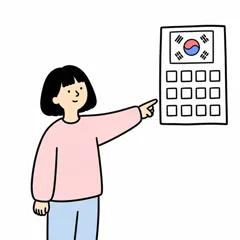
Tall vowels like ㅏ sit right of the first consonant, flat ones like ㅗ under it: 하, 호. A last consonant goes at the bottom.
at the end, said like ㄱ: a k with no puff
부엌
bueok · kitchen
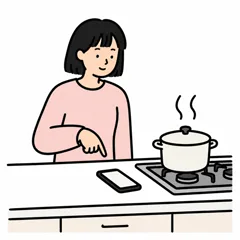
A word can end in only seven consonant sounds: k, t, p, m, n, ng and l. Every final letter comes out as one of them.
at the end, said like ㄷ: a t with no puff
옷
ot · clothes

Seven letters all end a word with this t: ㄷ ㅅ ㅆ ㅈ ㅊ ㅌ ㅎ. That’s why 꽃 is kkot.
at the end, said like ㅂ: a p with no puff
숲
sup · forest

Close your lips and stop, the way many people end yep: no puff of air after the p.
Letters that come in families
Tap one to hear it and see how to say it.
-
ㅅ, ㅈ and ㅊ are one family: each added stroke makes the sound stronger, from s to j to ch.
-
달 (moon), 탈 (mask) and 딸 (daughter) differ only in the first letter: plain, breathy, tight.
-
사요 (I buy) and 싸요 (it’s cheap) differ only here: ㅆ is tighter and hissier than ㅅ.
-
A second short stroke adds a y: ㅏ becomes ㅑ, and ㅓ, ㅗ and ㅜ work the same way.
-
ㅣ stands like a person and ㅡ lies flat like the ground: every vowel is built from these two and short strokes.
-
ㅎ grows out of ㅇ, a round, open throat: the strokes on top add the breath of h.
Quiz
Test yourself.
15 letters, one at a time. Pick the kind of question, then tap your answer, or press 1 to 4.
In the Misu app
Learn Hangul as flashcards.
Misu’s Hangul deck is 40 flashcards: the 10 basic vowels, the 14 consonants, the five tight double consonants, the compound vowels, and the sounds a block’s last letter makes. Each one has its sound, a tip, and a word from the course with its picture.
About three days at 15 new flashcards a day. Korean Foundations has no romanisation: every flashcard is in Hangul.
Get MisuQuick answers
How many letters are in the Korean alphabet?
24 basic letters: 14 consonants and 10 vowels. Five doubled consonants, like ㄲ, and 11 compound vowels, like ㅐ, make 40 in all.
How long does it take to learn Hangul?
A few days to read it slowly. Misu’s Hangul deck is 40 flashcards, about three days at 15 new flashcards a day.
How do Korean letters make syllables?
Each syllable is a block: a consonant, a vowel beside or under it, and sometimes a consonant at the bottom. 한 is ㅎ h, ㅏ a and ㄴ n.
Why does ㅇ have no sound?
At the start of a block it holds the place, so a syllable can start with a vowel: 아 is just a. At the bottom of a block it says ng, as in sing.
What is the difference between ㄷ, ㅌ and ㄸ?
ㄷ is plain, ㅌ adds a puff of air, and ㄸ is tight, with no puff. 달 (moon), 탈 (mask) and 딸 (daughter) differ only in the first letter.
Do I need romanisation to learn Korean?
No. Hangul takes days, and romanisation hides sounds like ㅓ and the tight consonants. Korean Foundations is all in Hangul.
Learn Hangul in Misu.
Misu’s Hangul deck: every letter with its sound, a tip and a word with its picture.
Get Misu