German · Free flashcards
German flashcards.
The 1,500 most common German words as flashcards, in 60 short lessons with audio. Pick a lesson and what to show first, then see how many you know.
- Free, no sign-up
- 60 lessons
- Print any lesson
Flashcard 1 of 27
0 known0 to review
Words to review
60 lessons · 1,500 words
Pick a lesson.
Each lesson is a deck of words you can use together, from greetings to the news. Lesson 1 is the app’s own flashcards, with pictures and sentences; the rest show the word, its audio and its meaning.
- Lesson 01 First steps das Wasser · der Kaffee · der Tee · bitte 27 words
- Lesson 02 People around you er · sie · es · wir 28 words
- Lesson 03 A little every day in · gehen · Wie geht’s? · wo 26 words
- Lesson 04 Make yourself at home das Haus · die Wohnung · der Tisch · der Stuhl 27 words
- Lesson 05 Find the words was · für · von · aus 25 words
- Lesson 06 Out and about kaufen · bezahlen · der Preis · das Geld 27 words
- Lesson 07 Connect the ideas sich · man · unser · euer 25 words
- Lesson 08 One day at a time kommen · woher · fahren · ankommen 28 words
- Lesson 09 Around the table der Hunger · der Durst · das Frühstück · frühstücken 28 words
- Lesson 10 Something to enjoy der Reis · die Nudel · der Apfel · die Banane 29 words
- Lesson 11 A little more each day die Arbeit · der Beruf · das Büro · die Schule 26 words
- Lesson 12 People around you der Vater · der Papa · die Mutter · die Mama 30 words
- Lesson 13 How things happen an · jemand · so · werden 27 words
- Lesson 14 Getting around das Auto · der Bus · das Taxi · der Zug 30 words
- Lesson 15 Days and plans die Stunde · die Minute · die Sekunde · der Monat 25 words
- Lesson 16 Everyday actions tun · lassen · halten · bringen 25 words
- Lesson 17 Connecting your thoughts denn · damit · selbst · nun 24 words
- Lesson 18 How you feel der Körper · der Kopf · das Gesicht · das Auge 26 words
- Lesson 19 Numbers in daily life null · elf · zwölf · dreizehn 28 words
- Lesson 20 A place to live die Miete · der Raum · die Wand · der Boden 26 words
- Lesson 21 Describing things schlecht · richtig · falsch · leicht 26 words
- Lesson 22 Colors and clothes die Farbe · rot · blau · grün 27 words
- Lesson 23 Feelings and reactions das Gefühl · die Angst · die Freude · der Spaß 27 words
- Lesson 24 Outside for a while das Wetter · draußen · die Sonne · scheinen 29 words
- Lesson 25 Adding a little detail bekannt · möglich · unmöglich · notwendig 26 words
- Lesson 26 Choices and changes erinnern · vergessen · entscheiden · wählen 25 words
- Lesson 27 Things you enjoy der Film · die Musik · das Lied · das Spiel 26 words
- Lesson 28 Messages and devices das Telefon · der Computer · funktionieren · das Internet 27 words
- Lesson 29 Linking ideas together gar · etwa · natürlich · recht 26 words
- Lesson 30 People, places and plans die Polizei · das Unternehmen · die Person · die Gesellschaft 25 words
- Lesson 31 Work and study die Firma · der Chef · der Koch · der Mitarbeiter 27 words
- Lesson 32 Making everyday plans bestellen · reservieren · buchen · mieten 30 words
- Lesson 33 Questions and connections außerdem · obwohl · sobald · solange 23 words
- Lesson 34 Reasons and outcomes schließlich · das Prozent · der Bereich · ernst 24 words
- Lesson 35 Views and possibilities der Blick · dagegen · ebenso · die Meinung 24 words
- Lesson 36 Making things work die Weise · übrigens · die Band · die Chance 25 words
- Lesson 37 Understanding situations häufig · die Kultur · der König · die Lösung 24 words
- Lesson 38 Everyday explanations der Politiker · die Politik · politisch · die Regel 24 words
- Lesson 39 Actions and changes fallen · verlassen · gefallen · nennen 26 words
- Lesson 40 Details that matter genauso · lediglich · die Liste · soweit 25 words
- Lesson 41 Dates and measurements der Januar · der Februar · der März · der April 27 words
- Lesson 42 Ideas and public life die Serie · ähnlich · der Beitrag · das Gebäude 25 words
- Lesson 43 Progress and perspectives die Freiheit · stolz · das Verfahren · zahlreich 25 words
- Lesson 44 Groups and resources immerhin · der Meister · das Volk · die Website 25 words
- Lesson 45 Places and reactions drinnen · hinten · vorne · innen 24 words
- Lesson 46 Causes and responses gelten · leisten · vertrauen · wirken 25 words
- Lesson 47 People and organizations der Betrieb · der Einfluss · das Gebiet · die Gegend 26 words
- Lesson 48 Help and practical needs das Krankenhaus · der Krankenwagen · die Apotheke · das Medikament 27 words
- Lesson 49 Describing everyday things jung · arm · kostenlos · öffentlich 24 words
- Lesson 50 Around town and beyond Deutschland · Österreich · die Schweiz · Europa 27 words
- Lesson 51 Food and ingredients die Frucht · die Beere · die Erdbeere · die Zitrone 26 words
- Lesson 52 People and nature der Hals · die Schulter · das Knie · die Zehe 26 words
- Lesson 53 Working with others die Organisation · der Dienst · der Autor · der Künstler 25 words
- Lesson 54 Clothes and home die Jeans · der Anzug · der Gürtel · der Handschuh 25 words
- Lesson 55 Getting things done interessieren · diskutieren · organisieren · sich kümmern 28 words
- Lesson 56 Understanding the news der Zustand · die Kontrolle · die Umwelt · die Forschung 25 words
- Lesson 57 Adding precision grundsätzlich · allgemein · wesentlich · offensichtlich 25 words
- Lesson 58 Arrivals and relatives die Verspätung · die Abfahrt · die Ankunft · der Ausgang 27 words
- Lesson 59 Everyday possibilities total · extrem · längst · tot 25 words
- Lesson 60 Keep talking schlagen · kriegen · das Risiko · die Stimmung 26 words
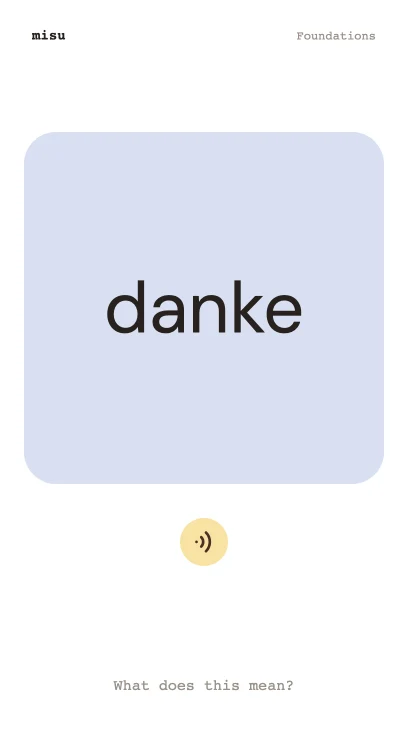
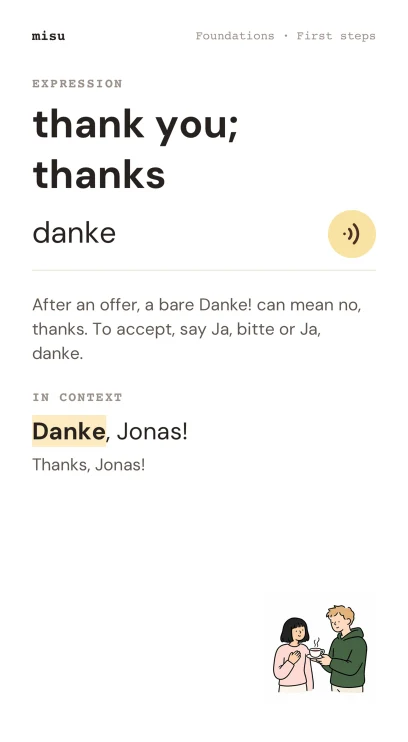
In the Misu app
Every flashcard, made for you.
In Misu, all 60 lessons look like lesson 1: a picture, an example and audio on every flashcard, and you can change any of it in the drag-and-drop editor.
FSRS plans your reviews and tunes itself to your memory every month. Plant a flower in your garden every day you review, and get a receipt of the words you learned each month.
Meet a new word on Netflix or YouTube? Save it with its sentence, and it becomes a flashcard too. Review offline on the train, and everything syncs, so you can switch phones and carry on.
Get MisuGerman flashcards
Are these German flashcards free?
Yes. Every lesson here is free, with no account. In the Misu app, the same flashcards keep your progress and come back for review on their own.
What words are in these flashcards?
The 1,500 most common German words, in 60 short lessons, in the order Misu’s course teaches them. Lesson 1 starts with das Wasser (water), der Kaffee (coffee), der Tee (tea) and bitte (please).
How do I study with them?
Look at the front and say what it means, out loud if you can. Then flip to check, and choose Knew it or Not yet. You can show the meaning or only the sound first instead, and the words you missed wait at the end for another go.
Can I print these German flashcards?
Yes. Pick a lesson and press Print: each word prints as a fold-over flashcard, the word on one half and its meaning on the other.
Can I make my own German flashcards?
Yes, in Misu. Type a word and Misu makes the flashcard for you, with a picture, an example and audio, and you can change anything in its drag-and-drop editor. You can also save words from Netflix, YouTube and any page.
Do the nouns come with their articles?
Yes, as in der Kaffee, die Entschuldigung and das Wasser, so you learn each noun’s gender along with it.
Keep every flashcard.
All 60 lessons are in Misu as beautiful flashcards, with pictures, examples and audio, and reviews tuned to your memory.
Get Misu